
June Meeting of the ACF Naples Chefs
- Stevan Stanisic

- Jun 17, 2015
- 4 min read
The American Culinary Federation (ACF) is a professional culinary organization with over 200 chapters and close to 20,000 members. It is the largest professional culinary organization in North America. It’s membership consists of chefs, other food industry professionals, enthusiasts and certainly a food blogger or two.
ACF offers educational, training, certification and charitable resources to members. Additionally, they publish a number of online periodicals such as The National Culinary Review, and provide member discounts on various Goods and Services.
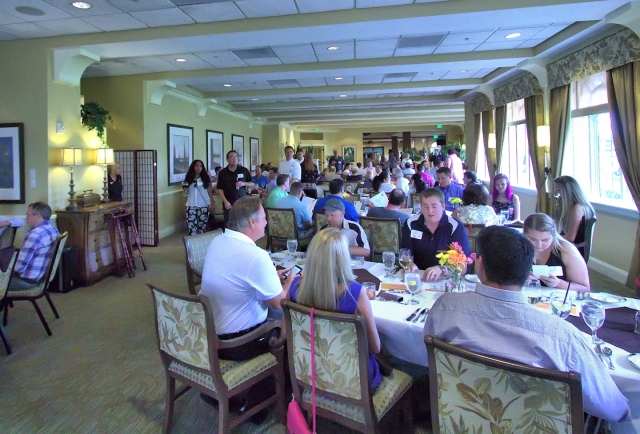
One of the chapters in Southwest Florida is the ACF Caxambas Chapter of Naples and Marco Island, or ACF Naples Chefs (ACFNC). With the exception of most winter months, ACFNC holds a monthly chapter meeting. These consist of a social/networking hour, followed by a discussion of chapter business and an educational component followed by a very nice sit down dinner.
This month’s meeting was held at The Spring Run Golf Club in Bonita Springs, FL.
Social hour was great, and the Joint was Jumpin’.
This was in part due to the menu that evening, which was very much over the top.
I loved the presentations for the social hour. Cornet-esq containers were filled with Charcuterie,
veggies with Hummus,
Koolickles, or picked vegetables soaked in Kool-Aid
and Jicama Fries, though these were cooked in lime juice.
Some very tasty sandwiches were next.
These were grilled cheese sandwiches, but with Taleggio cheese (sort of an Italian Brie), venison Brisket, apricot/caper spread and pecan-raisin bread.
Pork BellyHash was served with melted Raclette or Gruyere cheeses
and Lamb Belly on rosemary skewers with Micro Tangerine Lace/Mint Microgreens and Aji Amarillo-flavored Creme Fraiche.
There were also a variety of tropical and florida-grown fruit presentations like Mamey Sapote Ice Cream,
a beautifully carved watermelon full of carbonated fruit, the carbonation coming from dry ice,
candied Breadfruit (candied by cooking in Hot Tamale Candy) as well as Papaya or Mango shakes,
Kiwifruit with Passion Fruit puree,
roasted Quince with rosemary and pine nuts and
Sangria with compressed melons. What is that you may ask? Before adding the fruit they compress the melon in some of the sangria. This helps the fruit absorb the flavor and stops it from getting mushy after it’s been added. It’s nice chatting with a chef from time to time!
Lychees, Rambutans and pickled Starfruit finished off this culinary Tour de Force of tropical fruits.
I was beginning to know what it felt like to live in The Palace of Versailles before the French Revolution!
The educational component of the meeting that evening was certification.
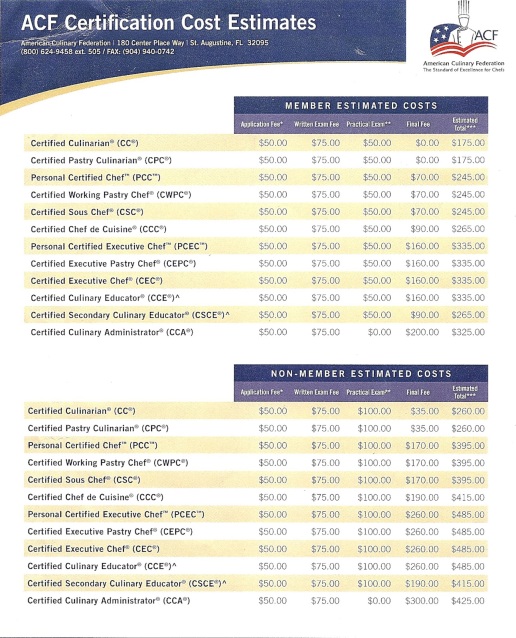
How does one become a chef? From what I am told, in the old days one could be self taught because all that was expected of a chef was to cook. That has changed with most professions including the culinary arts. Now chefs are expected to know about other matters including personnel management, accounting, nutrition, food safety and sanitation. One can learn these skills through cooking school, but a full course of study at Le Cordon Bleu or the Culinary Institute of America is about $50,000 and $130,000, respectively.
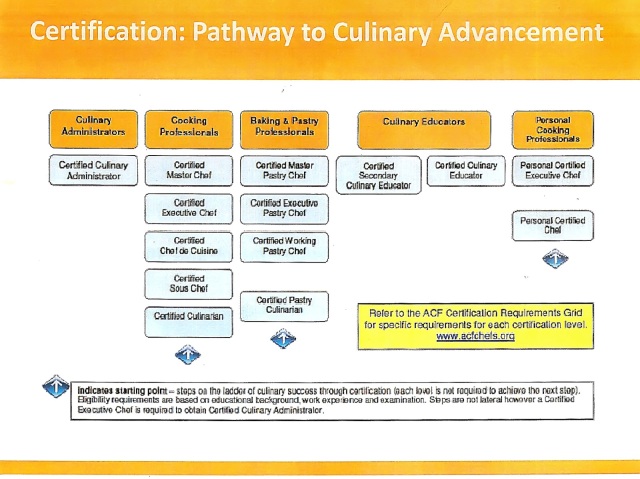
ACF Certification costs much less than a cooking school, though there can be a bit of “sweat equity” in the certification process.Here is a flow chart of the various certification levels,
the requirements,
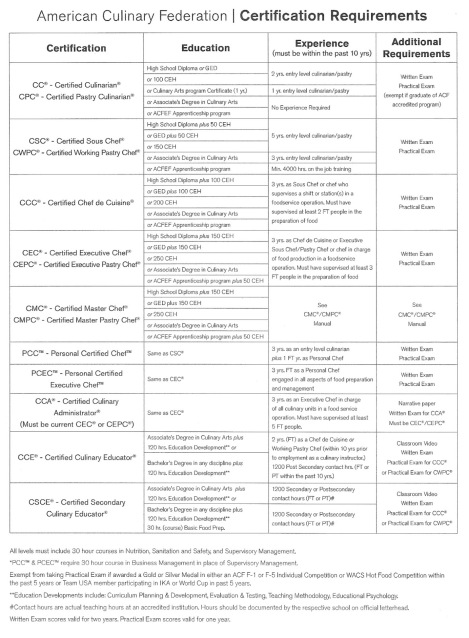
(CEH=Culinary Education Hours)
and the costs.
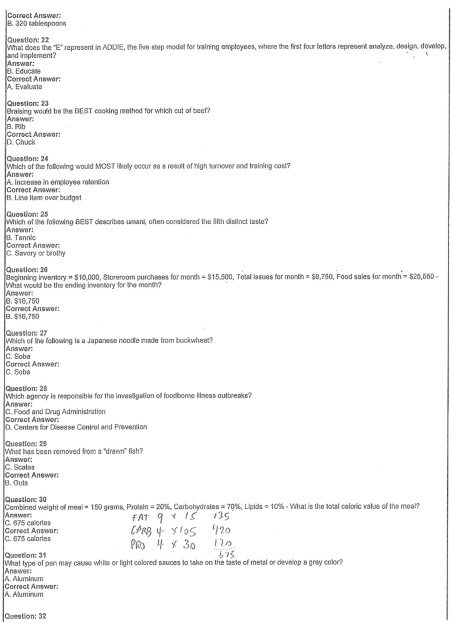
Once pre-approval requirements are met, applicants must take a written and practical exam.Here is a sample from the Certified Executive Chef written exam,
and a video from a practical Master Chef exam (this video may be too large to play on mobile devices, 17 MB).
Well, all this talk about certification made me hungry as I’m sure everyone else was.
The starter was a Peruvian-influenced salad.
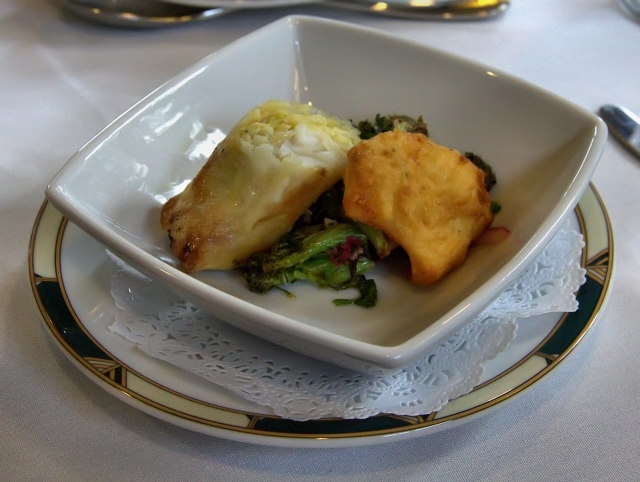
Here is how the Sous Chef, Jorge Villagomez, described it. “The spring roll had a blend of sauteed garlic, onions, jalapeño pepper, bell pepper, lime juice and Aji Amarillo paste mixed with cabbage along with two aji marinated grouper cheeks. The salad was a take on a Criolla salsa which is thin red onion, lime juice, Aji Amarillo, and Ricotto pepper. I added some minced garlic, micro cilantro, tangerine lace microgreens, and fried broccoli. There was also a lightly fried grouper cheek accompanying the plate.”The entree was a Veal and Pork cheek dish.
Again Chef Jorge describes. “The second course was veal and pork cheek braised for 12 hrs at 156 in our CVAP oven. The veal cheek was served as is, the pork cheek was sautéed with pork belly, garlic, shallots, and grilled asparagus over a parsnip purée, topped with lightly fried onion straws, Cabernet Demi and micro arugula.” Wow!Dessert was a combination of a Panna Cotta and Tres Leche Cake with mamey sapote ice cream. As I took my last bite of dessert I closed my eyes and for a second really thought I was in Versailles.
Hats off to Chef Jorge and Executive Chef Steve Joynt for this wonderful meal. Additionally, thanks to the food purveyors, The Port Royal Trading Company, Cheney Brothers, Happy Foods of Southwest Florida, Halpern’s and Swiss Chalet Fine Foods. This event would not have been possible without their largesse.
A member chef said those that host these monthly meetings put their best foot forward. Complete understatement.
Another totally over the top meal and another post on Forks.
ACF Caxambas Chapter of Naples & Marco Island (ACF Naples Chefs)President Chas Tatigian, CECPO Box 855Naples, FL 34106239.304.6045


Comments